
Private service-dog coaching • Washington
Service Dog Training
Individual training for approved dog-and-handler teams, including disability-related task development, public-behavior foundations, handler skills, generalization, and maintenance.
Insight K9 provides training—not disability diagnosis, legal certification, registration, or a guarantee of public access. The first step is determining whether the dog, handler, and requested work are a responsible fit.
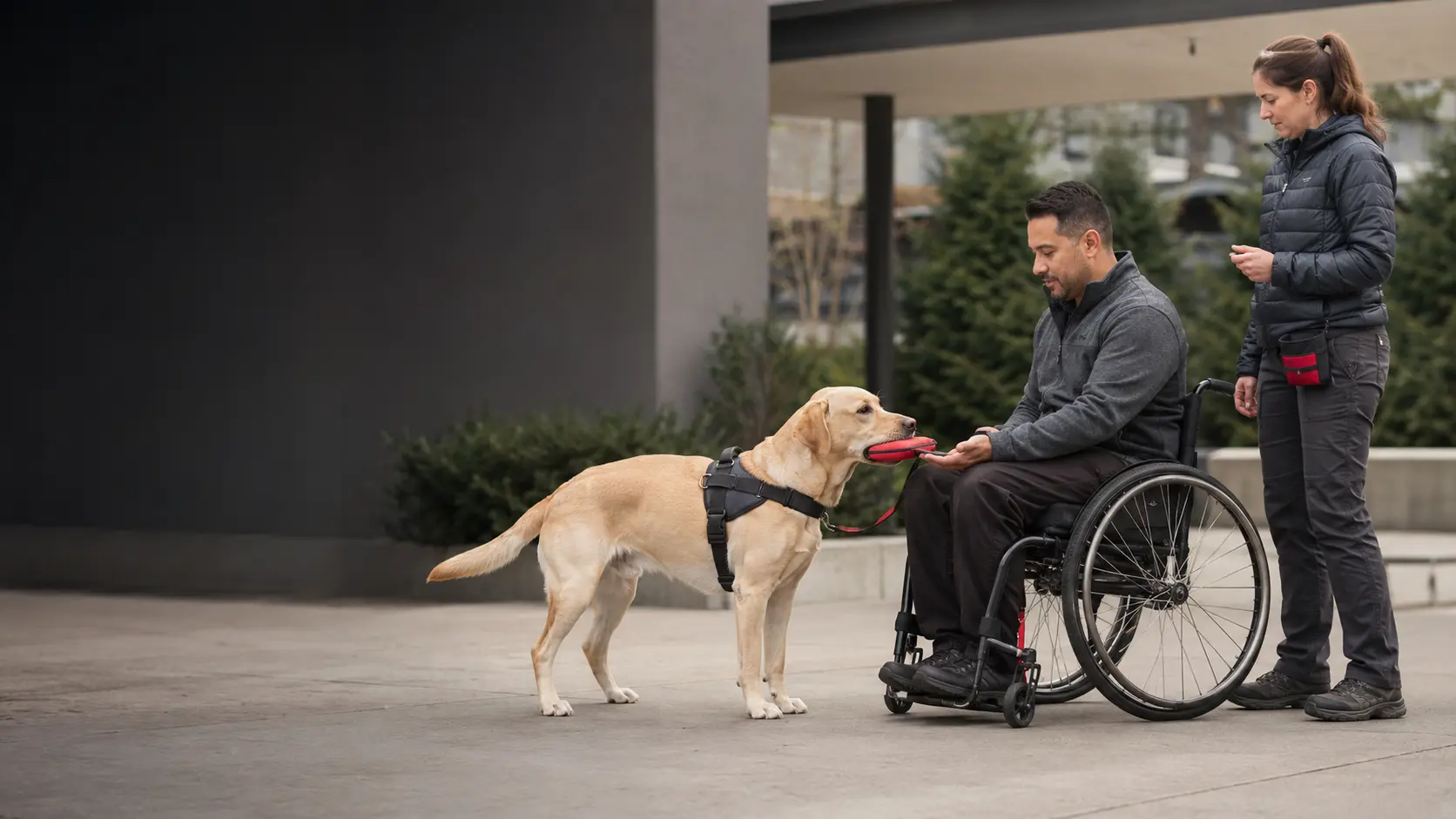
Purpose is demonstrated through trained work
A service dog is defined by tasks—not a vest or online certificate
Under the ADA, a service animal is a dog individually trained to do work or perform tasks directly related to a person’s disability. Comfort or emotional support by presence alone is not a disability-related task. A working team also needs control, house training, and behavior appropriate to the environment.
Professional training can help build those skills, but federal law does not require a professional program, service-dog registry, identification card, or vest. Insight K9 focuses on the dog’s observable training and the handler’s ability to maintain it.
Useful tasks, stable behavior, and a sustainable partnership
The dog must be able to perform trained work while remaining physically and emotionally able to handle the environments required by the handler.
Not every dog is suited to service work, and a dog that begins training may later need a different role. Welfare, safety, recovery, and honest ongoing review are part of responsible preparation.
Training matched to daily function
Who private service dog training may support
Insight K9 does not determine whether someone has a disability or issue legal credentials. We review the requested training, the individual dog, the handler’s goals, and the team’s ability to practice and maintain the work.
Owner-Trained Teams
Build a structured plan for foundation behavior, task development, public-behavior skills, troubleshooting, documentation of practice, and maintenance.
Prospective Dog Program-Fit Review
Review temperament, recovery, health considerations, environmental confidence, sociability, motivation, and the likely demands of the requested work.
Retrieval & Mobility Tasks
Develop appropriate tasks such as retrieving dropped items, carrying a light object, opening an accessible door setup, or positioning for daily routines.
Medical-Response Foundations
Train observable responses such as retrieving a kit, finding another person, activating an accessible device, interrupting a behavior, or supporting a routine.
Psychiatric Service Tasks
Build specifically trained actions related to a disability—such as interruption, grounding behavior, retrieval, or creating space—rather than comfort alone.
Existing Working Teams
Refresh task reliability, address environmental difficulties, rebuild reinforcement, improve handling, and create a sustainable maintenance plan.
Build the complete working partnership
What private service dog training may include
The program is shaped around the team’s starting point and functional goal. Training advances only when the dog demonstrates the necessary stability, understanding, health, and recovery.
Foundation Behavior
Develop reinforcement skills, leash manners, recalls, positions, duration, settling, house-training reliability, and engagement with the handler.
Disability-Related Tasks
Break a useful task into teachable steps, define a clear cue or context, build fluency, and confirm that the final behavior serves its intended function.
Neutrality & Recovery
Practice calm behavior around people, dogs, food, movement, sounds, surfaces, confined spaces, and ordinary public distractions without forcing exposure.
Public-Behavior Skills
Build unobtrusive positioning, controlled movement, settling, appropriate elimination habits, and the ability to leave or recover when an environment is too difficult.
Handler Mechanics
Practice cues, reinforcement, leash and equipment use, task setup, observation, advocacy, problem solving, and decisions that protect the team’s welfare.
Generalization & Maintenance
Transfer trained skills to appropriate locations, increase difficulty gradually, track reliability, prevent skill loss, and plan for changes in the dog or handler.
An individualized progression
How private service dog training works
You do not need to purchase a registry, vest, or online certificate before contacting us. Start by telling us about the assistance your family needs.
Define the function
Describe the daily barrier, the action that could help, the dog’s history and health, current behavior, environments involved, and your practice capacity.
Review the team
Your trainer observes temperament, recovery, confidence, sociability, motivation, physical considerations, foundation behavior, and handler mechanics.
Build tasks and stability
Teach the task in clear pieces while strengthening communication, neutrality, control, settling, and the dog’s ability to recover from reasonable challenge.
Generalize and maintain
Practice in appropriate environments, increase criteria gradually, record progress, troubleshoot weak points, and maintain skills throughout the dog’s working life.
Progress you can track
What a stronger service dog-and-handler team can look like
Progress should be measured against the team’s starting point and required function. Training cannot guarantee that every dog will complete service work or remain suited to every environment.
More Reliable Tasks
The dog performs the trained action more consistently in the contexts where it is needed, with clearer cues and less unnecessary prompting.
Calmer Public Behavior
The dog can settle, move with the handler, ignore ordinary distractions, remain under control, and recover or leave when conditions exceed current readiness.
Stronger Handler Skills
The handler better reads stress and recovery, reinforces accurately, protects task reliability, advocates for the team, and maintains training over time.
Real clients. Practical coaching.
What owners say about training with Insight K9
“Tyler in Tacoma was incredibly professional and effective. He gave us the tools and confidence to train our German Shepherd properly.”Matt D. — Lakewood, WA
“We worked with Payton in Maple Valley for our five-month-old Lab. I was amazed how quickly she learned commands and improved her impulse control.”Karen S. — Ravensdale, WA
Service dog training FAQs
Common questions before you begin
What makes a dog a service dog under the ADA?
Under titles II and III of the ADA, a service animal is a dog individually trained to do work or perform tasks for a person with a disability, and the work or tasks must be directly related to that disability. The dog’s presence, companionship, or comfort alone does not meet that task requirement.
Is a certificate, registration, vest, or public-access test required?
The ADA does not require federal certification, registration, professional training, a special identification card, or a vest. It also does not create one mandatory federal public-access test. Training evaluations can help measure readiness, but they do not create legal status or guarantee access.
Can a business ask for medical or training documentation?
When the dog’s role is not obvious, ADA-covered staff may generally ask only whether the dog is required because of a disability and what work or task the dog has been trained to perform. They may not require service-dog certification or ask that the dog demonstrate the task as a condition of entry. Different rules can apply in employment, housing, air travel, and other settings.
How is a service dog different from an emotional support or therapy dog?
A service dog is individually trained for disability-related work or tasks for its handler. Emotional support animals provide comfort through their presence and do not receive the same ADA public-access treatment. Therapy dogs are typically invited to provide comfort or interaction to other people in settings such as schools or care facilities.
Can any breed or any individual dog do service work?
The ADA does not limit service dogs by breed or size, but individual suitability still matters. Health, recovery, environmental confidence, sociability, trainability, task demands, household conditions, handler needs, and long-term welfare can all affect whether a particular dog is a responsible candidate.
Does the ADA control service-dog travel on airplanes?
Air travel is generally governed by the Air Carrier Access Act and U.S. Department of Transportation rules rather than the ADA public-accommodation rules. Airlines may require current DOT forms and apply safety and behavior requirements. Review the airline’s policy and the current DOT service-animal guidance before travel.
How long does service dog training take, and is completion guaranteed?
There is no universal timeline or guaranteed outcome. Progress depends on the tasks, starting skills, dog’s health and temperament, handler practice, environments, interruptions, and maintenance. A responsible program may recommend a career change if the dog is unsafe, persistently stressed, physically unsuitable, or unable to perform the required work reliably.
Private lessons across Washington
Find the right service-dog training path near you
Insight K9 serves multiple Washington communities. Task support and trainer availability can vary by location, dog-and-handler program-fit review, environment, and requested work, so contact us to identify the appropriate next step.
Start with the dog, the task, and the real daily need
Tell us about your dog, current training, the task you want to develop, environments involved, and any behavior or health considerations. We will help identify the appropriate trainer and next step.
Privacy for handler information: We request only handler health, accommodation, and service-dog task information needed to review or provide the service you request. Please do not enter unrelated health information. Review our Consumer Health Data Privacy Policy.