
Private working-dog coaching • Washington
Sport & Tracking Dog Training
Purposeful one-on-one training for tracking foundations, sport obedience, drive development, handler skills, and advanced dog-and-handler teamwork.
Insight K9 shapes each plan around the dog, the handler, and the discipline—whether you want a structured outlet, a new activity, stronger foundations, or a path toward more advanced goals.
Drive becomes useful through clarity
Give natural ability a job the team understands
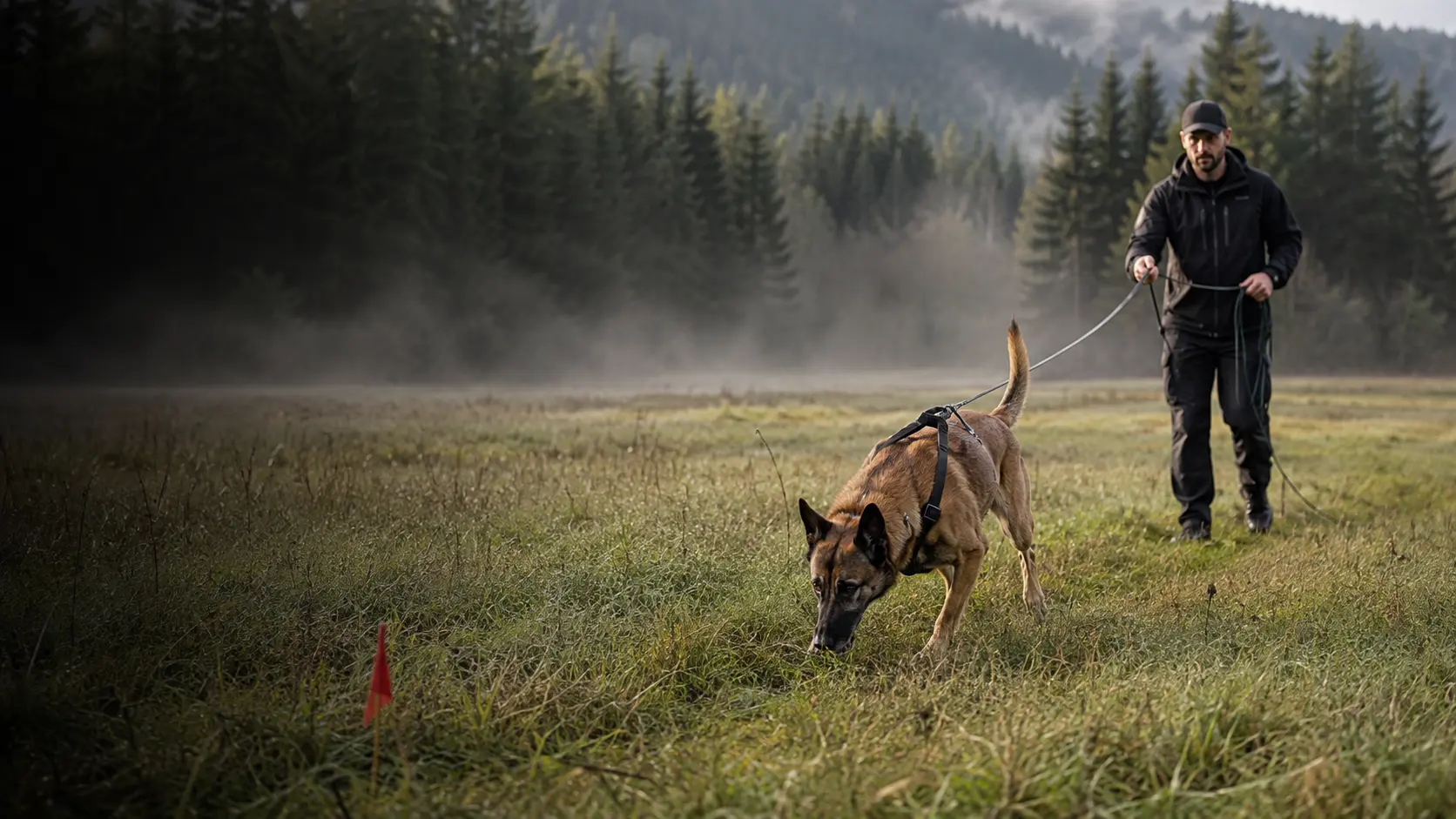
Sport training develops precise behaviors, motivation, speed, control, and the handler’s ability to communicate under increasing challenge. Tracking teaches a dog to follow a ground-scent trail with purpose while the handler manages the line and supports the work without supplying the answer.
Both disciplines depend on clean foundations. Reward placement, criteria, timing, physical readiness, environmental confidence, and thoughtful progressions matter more than simply making an exercise harder.
THE PRACTICAL GOAL
Enthusiastic work with dependable communication
The dog learns to engage the task, persist through reasonable difficulty, and remain responsive to the handler. The handler learns how to build motivation without losing clarity or control.
The result should be a stronger working partnership—not a dog rehearsing frantic energy or a handler chasing points before the foundation is ready.
Training matched to the team
Who sport and tracking training can serve
A dog does not need a title or prior competition experience to begin. We discuss the dog’s motivation, confidence, health, current skills, and the handler’s goals before choosing the right starting point.
Dogs New to Sport
Explore a structured activity while building reward skills, engagement, confidence, and the basic behaviors needed for future progression.
Beginning Tracking Teams
Learn track preparation, start routines, line handling, ground-scent commitment, article work, and how to read the dog without directing every step.
High-Drive Active Dogs
Channel energy and persistence into thoughtful work that asks the dog to focus, solve a problem, and cooperate with the handler.
Sport Obedience Teams
Develop cleaner positions, engagement, transitions, recalls, retrieves, duration, and control around distractions according to the chosen discipline.
Competition-Minded Handlers
Review current performance, identify weak foundations, and build a progression toward appropriate sport goals without guaranteeing titles or timelines.
Experienced Working Teams
Refine criteria, increase environmental difficulty, strengthen handler mechanics, and address specific performance problems after discussing goals and program fit.
Build the complete performance
What private sport and tracking training may include
The exact work depends on the discipline, team, environment, and intended goal. These components often develop together so enthusiasm, precision, and handler understanding remain balanced.
Drive & Reinforcement
Build useful motivation with food, toys, play, or access to the work while teaching the dog how to earn and receive reinforcement clearly.
Sport Obedience
Develop engagement, positions, movement, recalls, duration, retrieves, and transitions with criteria matched to the dog and chosen activity.
Tracking Foundations
Teach an organized start, commitment to the track, thoughtful corners, article behavior, pace, and persistence across suitable terrain.
Handler Mechanics
Practice timing, line handling, positioning, reward delivery, track laying, observation, and communication that supports rather than crowds the dog.
Environmental Confidence
Generalize skills to new fields, surfaces, weather, distractions, equipment, and work areas as the team demonstrates readiness.
Discipline-Specific Progression
Increase precision, duration, complexity, and independence according to the selected sport instead of applying one generic program to every team.
A responsible progression
How private sport and tracking training works
You do not need to choose a competition or title before contacting us. We can start with your dog’s interests and your goals.
Define the goal
Share the activity that interests you, the dog’s experience, current strengths, physical considerations, equipment, and how much time you can practice.
Review the team
Your trainer observes reward interest, confidence, control, movement, problem solving, handler mechanics, and suitability for the requested work.
Build the foundation
Establish clear reinforcement, engagement, start routines, core behaviors, and communication before demanding advanced precision or endurance.
Increase criteria
Add distance, duration, distractions, terrain, complexity, and discipline-specific challenges as performance becomes more consistent.
Progress you can track
What a stronger sport or tracking team can look like
Progress is individual and should be measured against the team’s starting point and selected discipline. The aim is repeatable performance with motivation, clarity, and responsible handling—not a promise that every dog will reach every goal.
Sustained Focus
The dog enters the work willingly, stays engaged through appropriate difficulty, and can transition between activity and control more clearly.
More Readable Tracking
The handler better recognizes commitment, uncertainty, loss of track, recovery, pace changes, and article behavior without overriding the dog.
Reliable Teamwork
Criteria, cues, rewards, movement, and handling become more consistent across practice sessions and increasingly challenging environments.
Real clients. Practical coaching.
What owners say about training with Insight K9
“Tyler in Tacoma was incredibly professional and effective. He gave us the tools and confidence to train our German Shepherd properly.”Matt D. — Lakewood, WA
“We worked with Payton in Maple Valley for our five-month-old Lab. I was amazed how quickly she learned commands and improved her impulse control.”Karen S. — Ravensdale, WA
Sport and tracking FAQs
Common questions before you begin
How is sport training different from ordinary obedience?
Everyday obedience prioritizes useful behavior in daily life. Sport training applies specific performance criteria such as precision, speed, duration, position, transitions, environmental confidence, or work within a formal exercise. Obedience foundations often support sport, but the selected discipline determines the final criteria.
Can a complete beginner start tracking?
Yes. Tracking can begin with simple, carefully prepared tracks and a clear reward system. The handler also learns how to lay a track, use markers, manage the line, record conditions, and read the dog. Starting correctly helps prevent the handler from pulling, cueing, or rushing the dog through the problem.
How is tracking different from odor detection?
Tracking generally asks a dog to follow a scent path or ground disturbance from a start to an end point. Odor detection asks the dog to search for and indicate a defined target odor. They share scent-work principles, but odor handling, search strategy, equipment, and final behavior differ. Visit our odor detection page if target-odor work is your primary goal.
Can you prepare my dog for a specific sport or competition?
Potentially. Availability depends on the discipline, trainer, location, dog-and-handler program-fit review, and current level. Contact us with the organization, class, exercise, or title you are considering. We will explain what support is available and whether another resource would be a better fit.
Does my dog need to be physically fit?
Physical demands vary. Tracking may be lower impact than jumping or fast directional work, but terrain, duration, heat, joints, nails, pads, and general conditioning still matter. Dogs with pain, recent injury, unusual fatigue, or medical restrictions should receive appropriate veterinary guidance before demanding activity.
What equipment should I buy?
Do not purchase a large equipment package before the evaluation. Depending on the goal, you may need a reward, leash or long line, tracking harness, markers, articles, appropriate footwear, and a way to record sessions. Your trainer can recommend what is useful and help you avoid unnecessary or poorly fitted equipment.
How long does sport or tracking training take?
There is no universal timeline. Progress depends on the discipline, starting skills, dog’s motivation and health, handler practice, environmental access, performance criteria, and final goal. Strong foundations usually save time later by reducing confusion when difficulty increases.
Private lessons across Washington
Find sport and tracking training near you
Insight K9 serves multiple Washington communities. Discipline availability can vary by trainer, equipment, terrain, and location, so contact us if you are unsure which trainer is the right fit.
Give your dog a purposeful challenge
Tell us about your dog, current training, the sport or tracking goal that interests you, and any physical considerations. We will help identify the appropriate trainer and next step.